RTP for EO

RTP for EO

RTP (Rubidium Titanyl Phosphate, RbTiOPO4) crystal features,

WB01158_1.GIF (255 bytes) Large electro-optic coefficients
WB01158_1.GIF (255 bytes) Large nonlinear optical coefficients
WB01158_1.GIF (255 bytes) No piezoelectric ringing to the MHz range
WB01158_1.GIF (255 bytes) Low operating voltage for Q-Switch
WB01158_1.GIF (255 bytes) Low ionic conductivity
WB01158_1.GIF (255 bytes) Nonhygroscopic, chemically and mechanically stable
WB01158_1.GIF (255 bytes) High damage threshold

making it an excellent material for E-O Q-switch at high repetition rates. RTP crystals are typically used in "thermally compensated double-crystal configurations" in which two matched crystals are placed along the propagation axis with one rotated by 90 deg. from the other (see the "Tech info" tab for more details).


orientation
attr_size
Model Name orientation attr_size Price Availability Action
RTP3100X RTP Crystal, Size 3x3x10mm, X-cut, X-faces AR coated @1064nm, Z-faces Au coated X-cut 3x3x10mm Ask Out Of Stock
RTP4100X RTP Crystal, Size 4x4x10mm, X-cut, X-faces AR coated @1064nm, Z-faces Au coated X-cut 4x4x10mm Ask Out Of Stock
RTP6070X RTP Crystal, Size 6x6x7mm, X-cut, X-faces AR coated @1064nm, Z-faces Au coated X-cut 6x6x7mm Ask Out Of Stock
RTP3070Y RTP Crystal, Size 3x3x7.0mm, Y-cut, Y-faces AR coated @1064nm, Z-faces Au coated Y-cut 3x3x7mm Ask Out Of Stock
RTP4100Y RTP Crystal, Size 4x4x10mm, Y-cut, Y-faces AR coated @1064nm, Z-faces Au coated Y-cut 4x4x10mm Ask Out Of Stock
RTP6070Y RTP Crystal, Size 6x6x7mm, Y-cut, Y-faces AR coated @1064nm, Z-faces Au coated Y-cut 6x6x7mm Ask Out Of Stock
Showing 1 to 6 of 6 (1 Pages)


RTP is a positive biaxial crystal, with the principal axes X, Y, and Z ( nz>ny>nx ) parallel to the crystallographic axes a, b, and c, respectively. 


Structural and Physical Properties:
 

Crystal Structure  

Orthorhombic. Point group mm2

Cell Parameters  

a=12.96 Å, b=10.56 Å, c=6.49 Å, Z=8

Melting Point  

1000 oC

Curie Point  

810 oC

Mohs Hardness  

 ~ 5

Density  

3.6 g/cm3

Color  

colorless

Hygroscopic Susceptibility

No

Thermal Expansion α1=1.01x10⁻⁵, α2=1.37x10⁻⁵, α3=-4.17x10⁻⁶
Dielectric constant  εeff=13  

Ionic conductivity  

 ~10-8 s/cm (c-axis, @ 25 oC, 10 kHz)


Linear Optical Properties:
 

Transmitting Range:     

 350 nm - 4500 nm      

Refractive Indices:
            1064 nm
             532 nm  

    nx             ny           nz
  1.7673      1.7760       1.8574
  1.8098      1.8227       1.9310

Sellmeier Equations:
(λ in µm) 

nx2=2.1556+0.93307λ2/(λ2-0.20994)-0.01452λ2
ny2=2.3849+0.073603λ2/(λ2-0.23891)-0.01583λ2
nz2=2.27723+1.11030λ2/(λ2-0.23454)-0.01995λ2

Thermo-optic Coefficients:  

dnx/dT= -  /oC, dny/dT= -  /oC
dnz/dT= -  /oC       ( N/A)

Absorption Coefficient:     

α < 0.05% cm-1 @ 1064 nm, α < 4% cm-1 @ 532 nm   


Electro-Optical and Nonlinear Optical Properties:
 

Electro-optic Coefficients
( x-cut, low frequency )
γ13=10.5 pm/V,   γ23=12.5 pm/V, γ33=35.0 pm/V
Half-wave Voltage@1064nm 1.6 kV for a pair of 4x4x10 mm crystals
3.4 kV for a pair of 6x6x7 mm crystals
2.4 kV for a pair of 6x6x10 mm crystals
Nonlinear Optical Coefficients d31=2.0 pm/V, d32=3.6 pm/V,
d33=8.3 pm/V,d24=3.6 pm/V,
d15=2.0 pm/V
Effective Nonlinearity deff(II)= (d24 - d15)sin2φsin2θ -(d15sin2φ+ d24cos2φ)sinθ


Specifications for RTP components:
 

 Transmitting wavefront distortion: less than λ/8 @ 633 nm 
 Dimension tolerance: (W +/- 0.1 mm) x (H +/- 0.1 mm) x (L + 0.2 mm/-0.1 mm) 
 Clear aperture: > 90% central area 
 Flatness: λ/8 @ 633 nm 
 Scratch/dig: 10/5 to MIL-O-13830A 
 Parallelism: better than 20 arc seconds 
 Perpendicularity: 30 arc minutes
 Angle tolerance: Δθ <  +/-0.25o, Δφ <  +/-0.25o


Paired crystals:

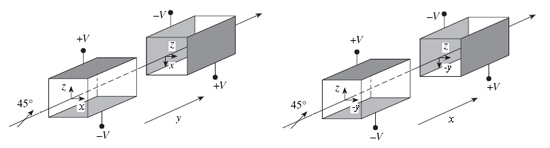
RTP crystals for EO modulation are typically used in "thermally compensated double-crystal configurations" as show below, in which two matched crystals are placed along the propagation axis with one rotated by 90 deg. from the other. The equivalent length of the EO modulator is 2 x of the individual crystal length.


Coatings:

The crystals are anti-reflection (AR) coated on the entrance/exit faces at the specified central wavelength. Gold (Au) coatings are deposited on Z-faces for the high voltage electrodes. Uncoated crystals are available upon request.