Thin/Ultrathin BBO Crystals

Thin/Ultrathin BBO Crystals

BBO crystal is by far the most useful nonlinear crystal for frequency conversions of ultrafast lasers. One of the main considerations for ultrafast applications is pulse broadening induced by the group velocity (Vg) mismatch between the input pulses and the generated pulse due to the dispersion in the crystal. In order to avoid pulse broadening, the thickness of the crystal should not exceed the maximum length Lmax as defined by the pulse width divided by the inversed group velocity mismatch (IGVM = ΔVg-1). In the table below are the Lmax for second harmonic generation (SHG) and sum frequency generation (SFG) of 10 fs pulses in the wavelength range of a common Ti:Sapphire laser,   
 

Type I PM  in BBO SHG @ 
700 nm
SHG @
800 nm
SHG @ 
900 nm
SFG @  
700 + 350 nm
SFG @ 
800 + 400 nm
SFG @
 900 + 450 nm
IGVM (ps/cm) 2.72 1.92 1.40 8.50 5.68 4.08
Lmax @10 fs (µm) 40 50 70 10 18 25


A thickness of sub-100 µm (0.1 mm) is apparently desired for all the frequency conversion processes of 10 fs pulses. In particular, crystals as thin as 10-20 µm may be needed for generation of very short UV wavelengths below 300 nm.  

Newlight Photonics offers on this page ultrathin/thin BBO crystals 10 µm (0.01 mm) - 3.0 mm thick developed for frequency conversions of short pulses. The typical apertures are 5x5 mm, 6x6 mm, 10x10 mm, 12x12 mm, and 15x15 mm.

We also supply birefringent calcite plates and alpha-BBO plates for compensation of the temporal walkoff in BBO crystals (time delay compensators).

For thicker BBO crystals (T>3 mm) for longer pulses (ns, ps), please visit  Thick BBO Crystals.

aperture
application
thickness
Model Name aperture application thickness Price Availability Action
BTC5001-SHG800(I)-P BBO crystal, size 5x5x0.01mm, for SHG of 800nm, P-coating, optical contacted on UVFS substrate, mounted 5x5mm 800nm SHG 0.01 mm USD$979.00
BTC5002-SHG800(I)-P BBO crystal, size 5x5x0.02mm, for SHG of 800nm, P-coating, optical contacted on UVFS substrate, mounted 5x5mm 800nm SHG 0.02 mm USD$949.00 Out Of Stock
BTC5005-SHG800(I)-P BBO crystal, size 5x5x0.05mm, for SHG of 800nm,free-standing (no glass substrate), P-coating, mounted 5x5mm 800nm SHG 0.05 mm USD$899.00
BTC5005-SHG470(I)-P BBO crystal, size 5x5x0.05mm, cut for SHG of 470 nm, free-standing (with no glass substrate), P-coating, mounted 5x5mm 470nm SHG 0.05 mm USD$939.00 Out Of Stock
BTC5005-SHG1550(I)-P BBO crystal, size 5x5x0.05mm, for SHG of 1550nm, P-coating, free-standing, OD 1" mounted 5x5mm 1550nm SHG 0.05 mm USD$939.00
BTC10005-SHG800(I)-P BBO crystal, size 10x10x0.05mm, for SHG of 800nm, P-coating, optical contacted on UVFS substrate 10x10mm 800nm SHG 0.05 mm Ask Out Of Stock
BTC5010-SHG800(I)-P BBO crystal, size 5x5x0.1mm, for Type I SHG of 800nm, P-coating, mounted 5x5mm 800nm SHG 0.1 mm USD$589.00 2-3 Days
BTC5010-SHG800(II)-P BBO crystal, size 5x5x0.1mm, for Type II SHG of 800nm, P-coating 5x5mm 800nm SHG 0.1 mm USD$589.00
BTC10010-SHG800(I)-P BBO crystal, size 10x10x0.1mm, for SHG of 800nm, P-coating, mounted 10x10mm 800nm SHG 0.1 mm USD$949.00
BTC5020-SHG800(I)-P BBO crystal, size 5x5x0.2mm, for SHG of 800nm, P-coating, OD 1" 5x5mm 800nm SHG 0.2 mm USD$579.00 Out Of Stock
BTC5020-SHG800(I)-AR BBO crystal, size 5x5x0.2mm, for SHG of 800nm, AR@800/400nm 5x5mm 800nm SHG 0.2 mm USD$609.00 Out Of Stock
BTC10020-SHG800(I)-P BBO crystal, size 10x10x0.2mm, for SHG of 800nm, P-coating 10x10mm 800nm SHG 0.2 mm Ask
BTC5020-SFG775/822(I)-AR BBO crystal, size 5 x 5 x 0.20mm, for Type I SFG of 775+822nm, AR coated 5x5mm 800nm SHG 0.2 mm USD$599.00 Out Of Stock
BTC5025-SHG800(I)-AR BBO crystal, size 5x5x0.25mm, for SHG of 800nm, AR coating@800/400nm 5x5mm 800nm SHG 0.25 mm USD$599.00
BTC5030-SHG800(I)-P BBO crystal, size 5x5x0.3mm, for SHG of 800nm, P-coating 5x5mm 800nm SHG 0.3 mm USD$579.00 Out Of Stock
Showing 1 to 15 of 114 (8 Pages)


Structural and Physical Properties:
 

Crystal Structure Trigonal, space group R3c, Point group 3m
Cell Parameters a = b = 12.532 Å, c = 12.717 Å, Z = 6
Melting Point 1095 °C
Transition Temperature 925 °C
Mohs Hardness 4
Density 3.85 g/cm3
Specific Heat 1.91 J/cmx K
Hygroscopic Susceptibility Low
Thermal Expansion Coefficients a, 4 x 10⁻⁶ /K;  c, 36 x 10-6 /K
Thermal Conductivity ⊥c, 1.2 W/m/K;  //c, 1.6 W/m/K


Linear Optical Properties:
 

Transparency Range 189-3500 nm
Optical Homogeneity δn ~ 10-6 /cm
Absorption Coefficient < 0.1% /cm (at 1064 nm)
Sellmeier Equations
 (λ in µm)
no2=2.7359+0.01878/(λ2-0.01822)-0.01354λ2
ne2=2.3753+0.01224/(λ2-0.01667)-0.01516λ2

Refractive Indices
               at 1064 nm 
               at 800 nm
               at 532 nm 
               at 400 nm
               at 266 nm  

 
no = 1.6545, ne = 1.5392
no = 1.6606, ne = 1.5444
no = 1.6742, ne = 1.5547
no = 1.6930, ne = 1.5679
no = 1.7585, ne = 1.6126
Thermo-optic Coefficients dno/dT = -9.3 x 10⁻⁶ /°C
dne/dT = -16.6 x 10⁻⁶ /°C


Nonlinear Optical Properties:


Phase-matchable SH Wavelengths 189 - 1750 nm
 
NLO Coefficients d11 = 5.8 x d36(KDP)
d31 = 0.05 x d11 
d22 < 0.05 x d11
Effective Nonlinearity Expressions dooe= d31 sinθ +(d11 cos3φ - d22 sin3φ) cosθ
deoe= (d11 sin3φ + d22 cos3φ) cos2θ
Electro-optic Coefficients γ11 = 2.7 pm/V, γ22, γ31 < 0.1 γ11
Half-wave Voltage 48 kV (at 1064 nm)
Damage Threshold (Bulk)
       at 1064 nm
       at 532 nm
 
5 GW/cm2 (10 ns); 10 GW/cm2 (1.3 ns)
1 GW/cm(10 ns); 7 GW/cm2 (250 ps)


Specifications of Thin BBO Components:
 

Wavefront distortion: less than λ/8 @ 633 nm
Clear aperture: > 90% central area
Flatness: λ/8 @ 633 nm
Scratch/Dig: 10/5 to MIL-O-13830A
Parallelism: better than 20 arc seconds
Angle tolerance:   Δθ < +/-0.25o, Δφ < +/-0.25o


Coatings:

BBO crystals are typically supplied with P-coating or AR coating on both faces,

1. Protective coating (P-coating): This is a single-layer MgF2 coating protecting a polished surface of BBO crystal from fogging due to ambient moisture. It also partially reduces reflection from the polished surface at a certain wavelength range.

Coating curve: P-coating (typical).

2. Anti-reflective coatings (AR coatings): These are multi-layer dielectric coatings. Single-band, dual-band or broad-band AR coatings on BBO surfaces are available upon request.

Coating curves: AR532/266nm, AR800/400nm, AR710/355nm (typical).

Uncoated crystals are available upon request. It is recommended that these crystals are used in a heated mount or a dry air/nitrogen environment to prevent surface degradation due to moisture.
 

Substrate:

Crystals with a thickness <50 µm (0.05 mm) are supplied optically contacted on a UV fused silica substrates ~ 2.0 mm thick. Crystals with a thickness 50 um and an aperture =< 6x6 mm can be free-standing (with no substrate). Crystals with a thickness >= 0.1 mm are always offered free-standing.
 

Angular tuning:

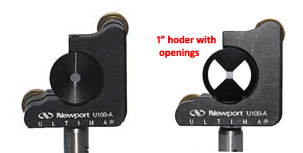
OD 1" crystals can be mounted in a conventional 1" mirror mount to be angle tuned for phase matching (mirror mounts and posts are not included).


BBO Crystal Handling:

BBO has a low susceptibility to moisture. The AR coating or the protective coating (P-coating) on the crystal faces can protect the faces from moisture to some extent. It is fine to leave the crystal in the  setup for most optics labs with HR =< 40%.  However, we suggest to store the crystal in a desiccator if it will not be used for over > 1 month to prolong the crystal lifetime. Alternatively, a small enclosure (with openings for light) may be built around the crystal with dry nitrogen or air continuously flow into the enclosure. The dry nitrogen/air pressure needs only to be slightly above the atmosphere to keep the small volume around the crystal dry and clean.

BBO is relatively soft and therefore requires precautions to protect the surfaces. 


Cleaning the Crystals:

Dust and stains on crystal surfaces can cause scattering/loss of light and can even react with light to damage optical surfaces at a high incident laser power.

You can inspect the crystal surface for dust and stains by holding it near a bright visible-light source. Viewing at different angles helps to see scattering from dust and stains. The crystal surface has to be cleaned if dust and stains are found.

You should perform the following cleaning procedures in a clean, low-dust environment while wearing powder-free gloves or finger cots.

Blowing off the crystal surface

A canister of compressed N2/clean air or a blower bulb (http://www.adorama.com/GTRABS.html ) can be used to blow off dust and other loose contaminants. If a dry nitrogen line is available in the lab, an air gun can also be used  to blow away dust particles. Blow off the surface gently. Do not blow off the crystal itself from your hand!

Do not use contact methods to remove dust or stains from the thin crystal surfaces.