Quartz Birefringent Filter Plates

The birefringent filter plate is a linear retarder made of a-cut (or 90o cut with the optical axis in the plate face) crystalline quartz and used intracavity to selectively tune a desired wavelength and create reflection losses at other wavelengths. In use, it is placed at Brewster’s angle, and then rotated about the axis perpendicular to the surface to achieve a full wave retardation at the wavelength of interest. The selected wavelength contains only a p-polarization component, and thus experience no reflection loss. Other wavelengths undergo a different retardation, and have some amount of s-polarization, leading to reflection losses.
A birefringent filter used in a short-pulse laser cavity can be a single quartz plate. A birefringent filter for a narrow linewidth CW laser can contain a stack of 2–4 quartz plates, each plate being half the thickness of the previous one. The thickest plate sets the bandwidth and the thinnest the free spectral range (FSR).
Reference:
 Birefringent filter for laser tuning: theory and design
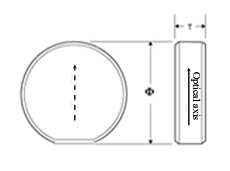
The birefringent filter plates in this page have a thickness of multiples of T (T=0.5mm) with the diameter of 1" or 0.5". More quartz plates/blocks with various apertures, thicknesses and coatings are available under the general "Quartz Crystals".