BiBO Crystals

BiBO Crystals

BiBO crystal features a large effective nonlinear coefficient (3.5 - 4 times higher than that of LBO, 1.5 - 2 times higher than that of BBO, ~ 8 times higher than that of KDP), high damage threshold and inertness to moisture. In particular it has been identified over the past years to be an efficient crystal for producing green or blue light through second harmonic generation (SHG) of Nd lasers or ultrafast TiS lasers. It also has an important application in efficient generation of ultrabright entangled photons through blue pumped spontaneous parametric down conversions (SPDC).

BiBO products on this page are thick crystals (T > 3 mm) for applications with picosecond (ps), nanosecond (ns), or long pulse/CW  lasers.

For thin BiBO products (T =< 3 mm) developed for frequency conversions of ultrafast femtosecond (fs) lasers, please visit thin BiBO crystals.
 
For BiBO products (including paired BiBO crystals) developed for spontaneous down conversions (SPDC), please visit SPDC components.


thickness
application
aperture
Model Name thickness application aperture Price Availability Action
BiBO3100-SHG650(I)-AR BiBO crystal with size 3x3x10mm, for Type I SHG of λ centred @ 650nm, AR coated @ 650/325nm, mounted 10.0 mm 650nm SHG 3x3mm Ask
BiBO3070-SHG710(I) BiBO crystal with size 3x3x7.0mm, for Type I SHG of λ centred @ 710 nm, uncoated, mounted 7.0 mm 710nm SHG 3x3mm USD$599.00
BiBO3100-SHG775(I)-AR BiBO crystal with size 3x3x10mm, for Type I SHG of λ centred @ 775 nm, coated @775/388nm 10.0 mm 775nm SHG 3x3mm Ask Out Of Stock
BiBO3050-SHG785(I)-AR BiBO crystal with size 3x3x5mm, for Type I SHG of λ centred @ 785 nm, coated @785/392nm 5.0 mm 785nm SHG 3x3mm Ask Out Of Stock
BiBO5050-SHG790(I)-AR BiBO crystal with size 5x5x5mm, for Type I SHG of λ centred @ 790 nm, coated @790/395nm 5.0 mm 790nm SHG 5x5mm Ask Out Of Stock
BiBO3050-SHG800(I)-AR BiBO crystal with size 3x3x5mm, for Type I SHG of λ centred @ 800 nm, coated @800/400nm 5.0 mm 800nm SHG 3x3mm Ask Out Of Stock
BiBO3060-SHG800(I)-B BiBO crystal with size 3x3x6mm, for Type I SHG of λ centred @ 800 nm, both ends cut at the Brewster angle 6.0 mm 800nm SHG 3x3mm Ask Out Of Stock
BiBO6700-SHG800(I) BiBO crystal with size 6x6x7mm, for Type I SHG of λ centred @ 800 nm, uncoated 7.0 mm 800nm SHG 6x6mm Ask Out Of Stock
BiBO3100-SHG800(I) BiBO crystal with size 3x3x10mm, for Type I SHG of λ centred @ 800 nm, uncoated 10.0 mm 800nm SHG 3x3mm USD$499.00
BiBO3100-SHG800(I)-AR BiBO crystal with size 3x3x10mm, for Type I SHG of λ centred @ 800 nm, coated AR@800/400nm, mounted in OD 1" holder 10.0 mm 800nm SHG 3x3mm Ask
BiBO3100-SHG800(I)-B BiBO crystal with size 3x3x10mm, for Type I SHG of λ centred @ 800 nm, both ends cut at the Brewster angle 10.0 mm 800nm SHG 3x3mm Ask Out Of Stock
BiBO3150-SHG808(I)-AR BiBO crystal with size 3x3x15mm, for Type I SHG of λ centred @ 808 nm, AR@808&404nm, mounted 15.0 mm 808nm SHG 3x3mm Ask Out Of Stock
BiBO3150-SHG880(I)-AR BiBO crystal with size 3x3x15mm, for Type I SHG of λ centred @ 880 nm, AR@880&440nm, mounted 15.0 mm 880nm SHG 3x3mm Ask Out Of Stock
BiBO3100-SHG914(I)-AR BiBO crystal with size 3x3x10mm, for Type I SHG of λ centred @ 914 nm, coated AR@914/457nm 10.0 mm 914nm SHG 3x3mm Ask Out Of Stock
BiBO3070-SHG946(I)-AR BiBO crystal with size 3x3x7.0mm, for Type I SHG of λ centred @ 946 nm, coated AR@946/473nm 7.0 mm 946nm SHG 3x3mm Ask Out Of Stock
Showing 1 to 15 of 29 (2 Pages)

Newlight's BiBO features:

WB01158_1.GIF (255 bytes) Broad transparent range from 286 nm to 2500 nm
WB01158_1.GIF (255 bytes) High optical homogeneity (δn ~ 10-6 /cm), free of inclusions
WB01158_1.GIF (255 bytes) Large effective SHG coefficient (~ 9 times that of KDP)
WB01158_1.GIF (255 bytes) High damage threshold
WB01158_1.GIF (255 bytes) Large temperature-bandwidth
WB01158_1.GIF (255 bytes) Inertness to moisture 
 

Structural and Physical Properties:

Crystal Structure    Monoclinic, Point group 2    
Lattice Parameters a=7.116 Å, b=4.993 Å, c=6.508 Å, β=105.6°, Z =2
Melting Point 726°C    
Mohs Hardness 5 - 5.5
Specific Heat 0.5 J/gm-K at 330 K
Thermal Expansion 4.8x10⁻⁵[X], 4.4x10⁻⁶[Y], -2.69x10⁻⁵[Z]
Density 5.033 g/cm3


Optical Properties:

Transmission Range

286-2500 nm
(Transmission Curve @200-800nmTransmission Curve @190-2600nm
)

NLO Coefficients d11=2.53 pm/V, d12=2.93 pm/V, d13=-1.93 pm/V, d14=1.63 pm/V
d25=1.67 pm/V, d26=3.48 pm/V
d35=-1.58 pm/V, d36=1.67 pm/V
(defined in the principal optical axes xyz: nz>ny>nx, x-1, y-2, z-3)
Refractive Indices @539.75 nm: nx = 1.7874, ny = 1.8190, nz = 1.9620
@1079.5 nm: nx = 1.7569, ny = 1.7835, nz = 1.9166
Sellmeier Equations
(λ in µm)
nx2=3.0740+0.0323/(λ2-0.0316)-0.01337λ2
ny2=3.1685+0.0373/(λ2-0.0346)-0.01750λ2
nz2=3.6545+0.0511/(λ2-0.0371)-0.0226λ2


Application examples:

WB01158_1.GIF (255 bytes) SHG and THG for middle and high power Nd: lasers at 1064 nm
WB01158_1.GIF (255 bytes) SHG and THG for high power Nd: lasers at 1342 &1319 nm for red and blue laser
WB01158_1.GIF (255 bytes) SHG for the Nd: Lasers at 914nm & 946nm for blue laser. Over 2.8 W CW blue
  @473 nm was obtained from frequency doubling of 4.6 W CW Nd:YAG
  @ 946 nm with BiBO
WB01158_1.GIF (255 bytes) Optical Parametric Amplifiers (OPA) and Oscillators (OPO)


Comparison of Nonlinear Optical Properties of Crystals for SHG @ 946 nm:

Crystals Length
(mm)
Deff
(pm/V)
Walk-off
(mrad)
Output Power(W)
 
Conversion  Efficiency
BiBO 10.4 3.3 40.7 2.8 63%
LBO 10 0.81 11.3 1.52 33%
BBO 8 2.0 60.3 2.1 47%


Specifications of BiBO components:
 

Wavefront Distortion: < λ/6  @ 633 nm for for Aperture =< 5mm, L =< 5mm
Dimension Tolerance:  (W+/-0.1 mm) x (H+/-0.1 mm) x (L+0.2/-0.1 mm)
Clear Aperture: > 90% central area
Flatness: Better than λ/6 @ 633 nm
Surface Quality:  Scratch/Dig 20/10 per MIL-O-13830A
Parallelism:     Better than 30 arc seconds
Perpendicularity:      5 arc minutes
Angle Tolerance:      Δθ < 0.25o, Δφ < 0.25o


Coatings:

Single-band, dual-band or broad-band AR coatings on BiBO crystals are available upon request.

Coating curves (Typical):

AR800/400 nm, AR1064/532 nm, AR1550/775 nm, AR1850/925 nm, BBAR centered ~ 700 nm


Angular tuning:
 

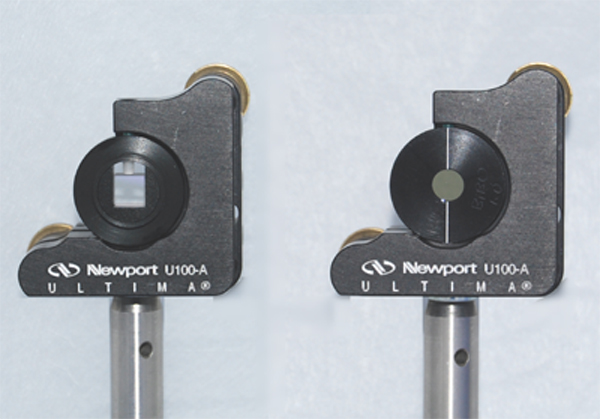
OD 1" crystals can be mounted in a conventional 1" mirror mount to be angle tuned for phase matching ( as shown to the right).  
 

BiBO Crystal Handling:

The susceptibility to moisture of BiBO is very low. However, users are advised to provide dry conditions for both use and storage of BiBO to prolong the lifetime. Water condensation on crystal surfaces should be absolutely avoided at any time.


Cleaning Crystals:
 

Dust and stains on crystal surfaces can cause scattering/loss of light and can even react with light to damage optical surfaces at a high incident laser power.

Inspect the crystal surface for dust and stains by holding it near a bright visible-light source. Viewing at different angles can help see scattering from dust and stains. The crystal surface has to be cleaned as described below if dust and stains are found.
 

Note: Perform the following cleaning procedures in a clean, low-dust environment while wearing powder-free gloves or finger cots.
 

1. Blowing off the crystal surface

Use a canister of compressed N2/clean air or a blower bulb (e.g., http://www.adorama.com/GTRABS.html )  to blow off dust and other loose contaminants first. If a dry nitrogen line is available in the lab, an air gun can also be used  to blow away dust particles. Blow off the surface gently. Do not blow off the crystal itself from your hand!

2. Drop and Drag Method

Hold the crystal so that the crystal surface is horizontal and slightly above your fingers. Take a fresh, clean sheet of lens tissue and place it on the crystal.  Make sure the lens tissue can be drawn across the crystal surface. Next, place a small drop of pure isopropyl alcohol (IPA) on the lens tissue on top of the crystal surface. The weight of the solvent will cause the lens tissue to come into contact with the crystal surface. Slowly but steadily drag the damp lens tissue across the crystal surface being careful not to lift the lens tissue off of the surface. Continue dragging the lens tissue until it is off of the surface.

The amount of the solvent can be adjusted for various crystal size so the lens tissue is kept damp for the entire drag but there is not any visible trace of solvent on the crystal surface after the drag is finished. Inspect the surface and repeat if necessary, but only use each sheet of lens tissue once.

If the crystal surfaces are still “dirty” after the above cleaning procedures, the surfaces might have been damaged. Please contact us for rework of the crystals.